
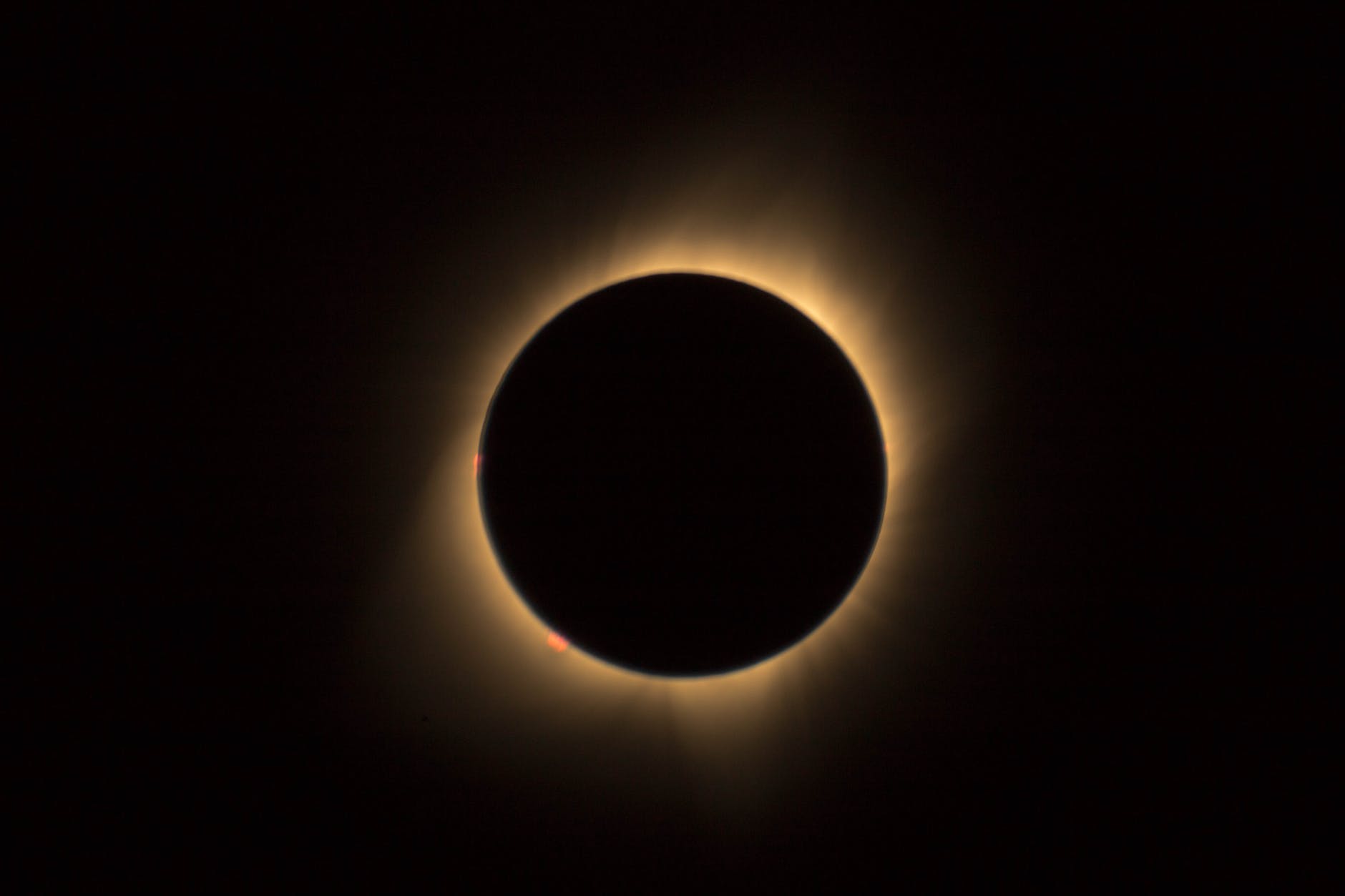
During a total solar eclipse, the Moon’s shadow falls on Earth and the Sun’s bright disk is completely covered by the Moon. This causes the sky to become dark and the Sun’s corona, or outer atmosphere, becomes visible. This is a rare and spectacular event that can only be seen from a narrow path on Earth’s surface.
This happens because the Sun is much larger than the Moon, and when the Moon passes between the Sun and Earth during a solar eclipse, it casts a shadow on Earth. The shadow has two parts because the Sun is not a point source of light, but rather an extended source. This means that the light from the Sun comes from different angles and is partially blocked by the Moon, creating two different shadows: the umbra and the penumbra.
During a partial solar eclipse, the Moon only partially covers the Sun’s disk and the sky does not become dark. The Sun appears to have a dark shadow on only a small part of its surface. Partial solar eclipses are more common than total solar eclipses and can be seen from a larger area on Earth’s surface.
Both total and partial solar eclipses are fascinating events to observe, but it is important to remember to never look directly at the Sun without proper eye protection.
During a solar eclipse, the moon casts two shadows on Earth. One is called the **umbra**, which is the darker inner part of the shadow where no direct sunlight penetrates. The other is called the **penumbra**, which is the lighter outer part of the shadow where light from only a part of the Sun’s disk reaches.
The next solar eclipse will be an annular or “ring of fire” solar eclipse on Oct. 14, 2023 and will be visible across North America, Central America, and most of South America.
 DO IT WITH PASSION OR NOT AT ALL